The 2002 WHI study scared a generation of women away from HRT. The 2026 evidence tells a fundamentally different story. Here is what changed, what the research actually shows, and what to ask your doctor.
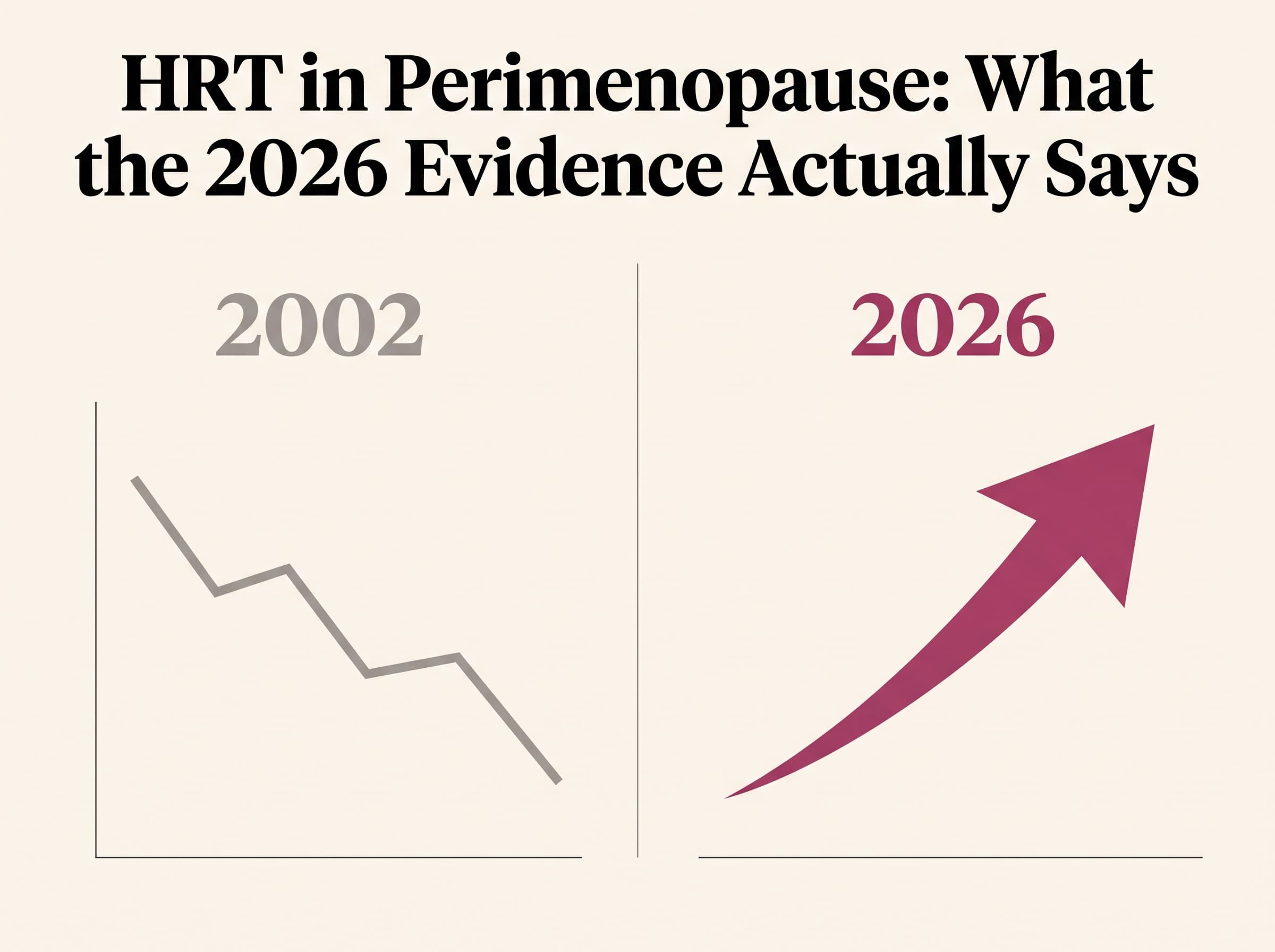
HRT in Perimenopause: What the 2026 Evidence Actually Says (And What Changed Since 2002)
In 2002, the Women's Health Initiative published findings that triggered one
of the most significant reversals in women's healthcare in modern history.
HRT prescriptions dropped by more than 50 percent within two years. An entire
generation of women experiencing perimenopause symptoms were told the risks
outweighed the benefits. Many suffered through years of preventable symptoms
because the treatment that could have helped had been effectively removed
from consideration.
What followed is a story of scientific correction that has been slow to reach
the women who need it most.
The 2026 evidence on HRT is substantially different from what the 2002 WHI
suggested — not because the original study was fabricated, but because
subsequent analysis revealed critical limitations in its design that
fundamentally changed how its results should be interpreted.
What the 2002 WHI Study Actually Showed — And What It Did Not
The Women's Health Initiative trial used two formulations: oral conjugated
equine estrogen combined with medroxyprogesterone acetate, a synthetic
progestogen, in women whose average age was 63 years — more than a decade
past the average age of menopause onset.
This matters enormously for how the findings apply to perimenopausal women
in their 40s.
Oral conjugated equine estrogen passes through the liver on first pass,
producing inflammatory effects on clotting factors that transdermal estrogen
does not produce. Medroxyprogesterone acetate is a synthetic compound with a
different risk profile from micronized progesterone, the bioidentical form
now most commonly prescribed.
The age of the study population matters because the timing hypothesis —
now one of the most significant concepts in menopause medicine — posits that
the cardiovascular and neuroprotective benefits of estrogen depend critically
on when treatment begins relative to menopause onset. Estrogen initiated within
ten years of menopause onset appears to have a protective cardiovascular effect.
Estrogen initiated more than ten years after menopause onset may have a
different and potentially adverse effect.
The WHI studied women an average of twelve years past menopause. Its findings
were then applied to women in their 40s in early perimenopause. The populations
are not comparable.
Re-analysis of WHI data for women who began HRT within ten years of menopause
onset showed a 30% reduction in cardiovascular mortality compared to placebo —
the opposite of the headline finding that applied to the full study population.
What the 2026 Evidence Shows
Transdermal Estradiol Is Not the Same as Oral Conjugated Estrogen
The most clinically significant development in HRT prescribing since the WHI
is the shift to transdermal estradiol — delivered via patch, gel, or
spray — as the preferred estrogen formulation.
Transdermal estradiol bypasses the liver's first-pass metabolism. This
eliminates the liver-mediated effects on clotting factors associated with
increased stroke and thrombosis risk in oral estrogen users. Multiple large
observational studies and meta-analyses have found that transdermal estradiol
carries no meaningful increase in venous thromboembolism risk compared
to non-users — a fundamentally different risk profile from oral formulations.
Micronized Progesterone Is Not the Same as Synthetic Progestogens
The progestogen component matters as much as the estrogen component.
Micronized progesterone — chemically identical to the progesterone the
body produces — has a different risk profile from the synthetic progestogens
used in the original WHI. The association between HRT and breast cancer that
drove much of the initial concern appears to be driven primarily by synthetic
progestogens rather than by micronized progesterone, based on analysis of
the French E3N cohort and subsequent large studies.
Current evidence suggests that transdermal estradiol combined with micronized
progesterone represents the lowest risk formulation of combined HRT
available, with a risk-benefit profile substantially different from what
was studied in the WHI.
What HRT Actually Does for Perimenopause Symptoms
The evidence for HRT's effectiveness in managing perimenopause symptoms is
among the strongest in women's health:
- Vasomotor symptoms (hot flashes, night sweats): 75 to 90 percent
reduction in clinical trials — the most effective treatment available - Sleep disruption: improves through both direct effects on sleep
architecture and indirect effects via vasomotor symptom reduction - Mood and anxiety: significant improvement documented, particularly
when symptoms are driven by hormonal fluctuation - Brain fog: improvement seen in women who start HRT during perimenopause,
particularly for verbal memory and processing speed - Bone density: well-established protective effect against osteoporosis
- Genitourinary symptoms: significant improvement in vaginal dryness,
urinary urgency, and discomfort
Who Is and Is Not a Candidate
HRT is not appropriate for every woman and the decision requires individual
clinical assessment.
Generally considered appropriate for women experiencing significant
symptoms impacting quality of life, with no personal history of
hormone-sensitive cancers, no unexplained vaginal bleeding, and no active
liver disease or uncontrolled cardiovascular risk factors.
Requires careful evaluation for women with a personal or strong family
history of breast cancer, history of venous thromboembolism, cardiovascular
disease, or migraine with aura. These are not automatic contraindications
to all forms of HRT but require specialist input.
The important clinical point: the contraindications to oral conjugated
equine estrogen are not identical to the contraindications to transdermal
estradiol with micronized progesterone. Women told they could not use HRT
based on older formulation criteria should discuss their situation with a
menopause specialist rather than assuming that decision still applies.
Questions to Bring to Your Doctor
- Which specific formulation would you recommend — and is it transdermal
estradiol with micronized progesterone? - Based on my age and how recently my symptoms started, where does the timing
hypothesis place me in terms of risk-benefit? - Are there aspects of my personal or family medical history that change
the risk calculation? - How will we monitor effectiveness and adjust formulation if needed?
For a complete guide to navigating the HRT conversation and understanding
the evidence on all available treatment options, visit
perimenopauseedit.estorealm.com.
Frequently Asked Questions
Does HRT cause breast cancer?
The relationship is more nuanced than public perception suggests. The
increased risk in the WHI appeared primarily in women using synthetic
progestogens, not micronized progesterone. Analysis of HRT containing
micronized progesterone has found no significant increase in breast cancer
risk, with some studies showing neutral or slightly reduced risk. The picture
requires significant qualification based on formulation and individual history.
How long can I stay on HRT?
There is no universal maximum duration based on current evidence. The previous
recommendation to limit HRT to five years has been substantially revised.
Current guidance from The Menopause Society supports continued use as long
as benefits outweigh risks on an individualized basis, reviewed annually.
Can I start HRT while still having periods?
Yes. HRT can be initiated during perimenopause while cycles are still
occurring. The formulation differs from that used after menopause to account
for residual ovarian function. A menopause specialist can advise on the
appropriate starting formulation based on your cycle status.
What is the difference between bioidentical and body-identical HRT?
Body-identical HRT refers to regulated pharmaceutical preparations chemically
identical to hormones the human body produces — specifically 17-beta estradiol
and micronized progesterone. These are available on prescription and are what
most menopause specialists now recommend. Compounded bioidentical preparations
from compounding pharmacies are different — not regulated in the same way,
without the same evidence base, and variable in consistency.
I was told HRT was not suitable for me years ago. Should I get a second opinion?
Yes, if that assessment was made more than five years ago or by a clinician
without menopause specialization. The field has moved significantly and what
was considered a contraindication may need reassessment in light of newer
formulations and updated evidence.
This article is for educational purposes only and does not constitute medical
advice. HRT decisions require individualized clinical assessment. Please consult
a qualified healthcare provider or menopause specialist for guidance specific
to your health history.
More from The Perimenopause Edit
What Perimenopause Does to Your Bones (And the Window You Cannot Afford to Miss)
Bone density loss accelerates dramatically in the years around perimenopause. The interventions that protect it must begin before significant loss has occurred. Here is the evidence on the window, the risks, and what actually works.
The Nutrition Formula That Actually Works for Women After 40 in Perimenopause
Nutritional requirements change in perimenopause in specific, documented ways. The formula that works after 40 is not a clean eating plan. It is a targeted approach addressing the hormonal, metabolic, and structural changes that make standard dietary advice insufficient.
The Neurochemical Reason Your Mood and Anxiety Changed in Perimenopause
New-onset anxiety in your 40s with no clear life trigger is not a psychological problem. It is a neurochemical one. Here is the mechanism and what addresses it at the level it is actually occurring.
The next the perimenopause edit essay in your inbox.
One careful letter, every Sunday. Free.