New-onset anxiety in your 40s with no clear life trigger is not a psychological problem. It is a neurochemical one. Here is the mechanism and what addresses it at the level it is actually occurring.
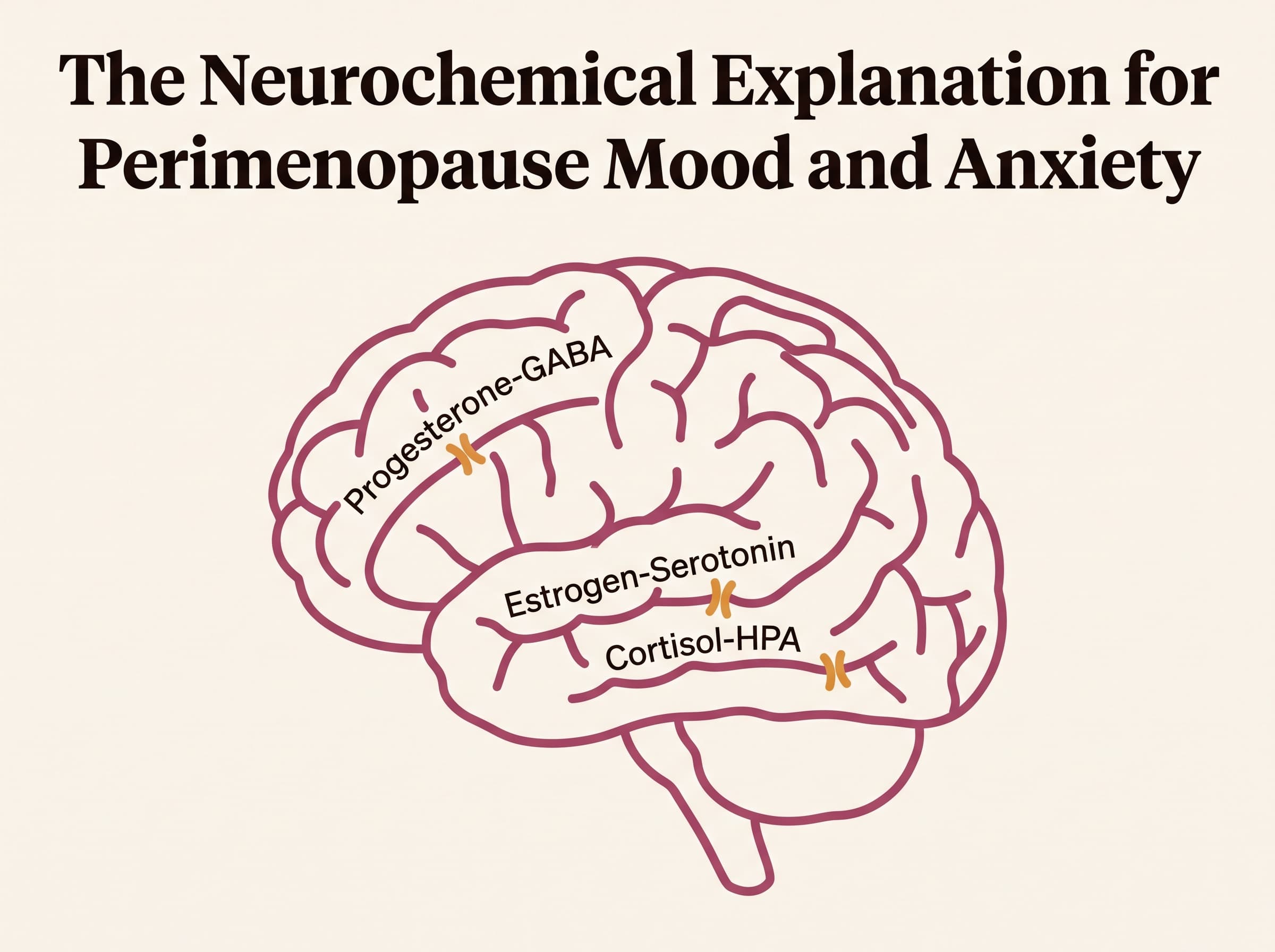
The Neurochemical Reason Your Mood and Anxiety Changed in Perimenopause
Approximately 40 percent of perimenopausal women report new or
significantly worsened anxiety with no clear precipitating psychological
stressor or life event.
This number is significant not just because of its size but because of what
it implies. A change of this consistency and scale, occurring in a specific
demographic at a specific life stage, without a consistent psychological
explanation, is almost certainly biological. And it is.
The mood and anxiety changes of perimenopause are neurochemical events driven
by the same hormonal fluctuations producing every other symptom of the
transition. Understanding the mechanism changes how these symptoms should be
assessed, approached, and treated.
The Three Neurochemical Mechanisms
Mechanism 1: Progesterone-GABA Withdrawal
This is the mechanism most directly responsible for the new-onset anxiety
that many perimenopausal women experience.
Progesterone is metabolized in the brain into allopregnanolone, a
neurosteroid that acts as a positive allosteric modulator of GABA-A receptors
— the brain's primary inhibitory receptors. Allopregnanolone has anxiolytic
effects that operate similarly to benzodiazepines, providing a baseline
inhibitory tone to the nervous system that buffers against anxiety and
emotional reactivity.
As progesterone levels fluctuate and eventually decline in perimenopause,
this allopregnanolone-mediated GABAergic buffer reduces. The nervous
system's inhibitory brake weakens. The threshold for anxiety activation
lowers. Responses to stressors that previously felt manageable begin to
feel disproportionate. A background level of anxiety appears that was
not present before and has no obvious psychological explanation because
it does not have a psychological origin.
This is the mechanism behind the perimenopause rage that women describe —
disproportionate, rapid-onset emotional reactivity that feels foreign to their
sense of themselves. It is not a personality change. It is a neurochemical
change that is removing the buffer that was always managing that reactivity
in the background.
Mechanism 2: Estrogen-Serotonin and Dopamine Disruption
Estrogen has direct effects on the serotonin and dopamine systems — the
neurotransmitter networks most associated with mood regulation, motivation,
and emotional stability.
Estrogen upregulates serotonin receptor sensitivity, increases serotonin
synthesis, and reduces the rate at which serotonin is broken down. When
estrogen fluctuates during perimenopause, serotonin signaling becomes
less stable. The result is the mood variability that many perimenopausal
women describe: days of normal mood followed by days of inexplicable low mood
or emotional flatness, cycling in a pattern that correlates with hormonal
fluctuation rather than with life events.
Estrogen also affects dopamine signaling and the reward system. The loss of
motivation, reduced pleasure in activities that were previously enjoyable,
and the emotional flatness that some women experience in perimenopause have
a dopaminergic component alongside the serotonergic one.
Mechanism 3: HPA Axis Dysregulation and Cortisol Volatility
The hypothalamic-pituitary-adrenal axis — the hormonal system governing the
stress response — becomes less stable during perimenopause. Cortisol responses
to stressors become more reactive and take longer to return to baseline.
This produces a physiological experience of being more on edge, more easily
activated by stressors that previously did not produce a significant stress
response, and slower to recover after activation. This is experienced as
anxiety and emotional irritability but its origin is the HPA axis instability
produced by the changing hormonal environment, not a psychological vulnerability.
40% of perimenopausal women report new or significantly worsened anxiety with
no clear psychological trigger. This symptom is among the most frequently
misattributed perimenopausal presentations, most commonly being diagnosed
as a primary anxiety disorder and treated without hormonal context.
Why This Distinction Matters for Treatment
The neurochemical origin of perimenopausal mood and anxiety symptoms matters
clinically because the first-line treatment for a psychological anxiety
disorder and the first-line treatment for neurochemically-driven perimenopausal
anxiety are different.
A primary anxiety disorder responds to psychological interventions — CBT,
exposure therapy, mindfulness-based approaches — as first-line treatment.
These interventions help with perimenopausal anxiety but address symptoms
rather than the neurochemical driver.
An SSRI or SNRI changes how serotonin is processed in the synapse. It can
reduce perimenopausal mood symptoms for some women, particularly those with
significant mood disruption. But it does not address the progesterone-GABA
withdrawal mechanism, the HPA axis instability, or the estrogen-serotonin
fluctuation that is driving the symptoms.
Hormonal treatment — specifically transdermal estradiol with micronized
progesterone — addresses the upstream neurochemical driver directly.
Micronized progesterone restores allopregnanolone production and the
GABAergic buffer that perimenopause is withdrawing. Estradiol stabilizes
the serotonergic and dopaminergic environments that estrogen fluctuation
is disrupting.
The clinical approach that produces the most complete resolution of
perimenopausal mood and anxiety symptoms is usually one that addresses
the hormonal layer first and adds psychological or pharmacological support
where residual symptoms remain.
Non-Hormonal Approaches With Clinical Evidence
For women who are not candidates for hormonal treatment or who prefer
non-hormonal approaches:
Magnesium glycinate at 300 to 400mg daily activates GABA-A receptors
through a different binding site than allopregnanolone, partially compensating
for the progesterone-GABA withdrawal. It is one of the most consistent
non-hormonal interventions for perimenopausal anxiety in clinical practice.
Ashwagandha KSM-66 at 300 to 600mg daily has demonstrated significant
cortisol reduction and anxiety improvement in multiple randomized controlled
trials, addressing the HPA axis instability component.
Cognitive behavioral therapy adapted for the perimenopausal context —
specifically working with the catastrophizing and health anxiety that
frequently accompany perimenopause — produces meaningful symptom improvement
and builds the regulatory capacity that makes the transition more manageable
regardless of whether hormonal treatment is used.
Regular resistance exercise has direct effects on GABA receptor
sensitivity, serotonin synthesis, and cortisol regulation that are directly
relevant to the perimenopausal anxiety mechanisms described above.
When to Seek Clinical Assessment
New-onset anxiety or significant mood change in a woman in her 40s warrants
clinical assessment that specifically includes hormonal evaluation, not only
a psychological or psychiatric assessment. The relevant workup includes
estradiol, progesterone, FSH, and thyroid function at minimum.
If you have been assessed and treated for anxiety or depression without
improvement, and you are in your 40s, hormonal assessment is appropriate
regardless of whether other perimenopausal symptoms are present.
For more on the neurochemical mechanisms of perimenopausal mood and anxiety
and the full evidence on treatment options, visit
perimenopauseedit.estorealm.com.
Frequently Asked Questions
Is perimenopause anxiety different from regular anxiety disorder?
Yes, in origin though not always in experience. Perimenopause anxiety is
driven by neurochemical changes — specifically progesterone-GABA withdrawal
and HPA axis dysregulation — rather than by psychological vulnerability or
learned anxiety responses. The experience can feel identical to anxiety
disorder, but the appropriate treatment differs. Hormonal evaluation should
be part of the assessment for any woman in her 40s with new-onset anxiety.
Can perimenopause cause depression?
Yes. Perimenopause is associated with significantly increased risk of
depressive episodes, even in women with no prior depression history.
The mechanism involves estrogen-serotonin disruption, sleep deprivation
from nocturnal symptoms, and the cortisol dysregulation that accompanies
HPA axis instability. Perimenopausal depression often presents differently
from primary depression — more irritability and anxiety mixed with low mood,
and more correlation with the cycle pattern.
Will the anxiety go away when I reach menopause?
For many women, mood and anxiety symptoms improve after the hormonal
fluctuation of perimenopause stabilizes at menopause — the transition itself
produces more symptoms than the stable post-menopausal state. However this
is not universal. Women with significant perimenopausal mood symptoms should
not wait for menopause to resolve them; effective interventions are available
throughout the transition.
Why do some days feel completely normal and others feel unbearable?
The day-to-day variability of perimenopausal mood symptoms reflects the
fluctuating rather than steadily declining nature of perimenopause hormones.
Good days correlate with hormonal environments that maintain adequate
progesterone and estrogen signaling. Difficult days correlate with hormonal
troughs. This fluctuating pattern — distinct from the more consistent
presentation of primary depression or anxiety disorder — is itself a
diagnostic indicator of the hormonal driver.
Should I try antidepressants for perimenopausal anxiety and mood?
SSRIs and SNRIs can provide meaningful symptom relief for some women with
perimenopausal mood symptoms, particularly when mood disruption is significant.
However they should not be the automatic first response to new-onset anxiety
or depression in a woman in her 40s without hormonal evaluation. The decision
to use antidepressants alongside, instead of, or after hormonal treatment
depends on the severity of symptoms, individual health history, and clinical
assessment — and ideally involves a clinician familiar with perimenopause.
This article is for educational purposes only and does not constitute medical
or psychiatric advice. Please consult a qualified healthcare provider for
assessment and treatment of mood and anxiety symptoms.
More from The Perimenopause Edit
What Perimenopause Does to Your Bones (And the Window You Cannot Afford to Miss)
Bone density loss accelerates dramatically in the years around perimenopause. The interventions that protect it must begin before significant loss has occurred. Here is the evidence on the window, the risks, and what actually works.
The Nutrition Formula That Actually Works for Women After 40 in Perimenopause
Nutritional requirements change in perimenopause in specific, documented ways. The formula that works after 40 is not a clean eating plan. It is a targeted approach addressing the hormonal, metabolic, and structural changes that make standard dietary advice insufficient.
Why Your Weight Changed After 40 Even Though Nothing Else Did
Eating the same. Moving the same. Weight redistributing anyway. The explanation is hormonal and the interventions that work address the hormonal environment, not just the calories.
The next the perimenopause edit essay in your inbox.
One careful letter, every Sunday. Free.