Eating the same. Moving the same. Weight redistributing anyway. The explanation is hormonal and the interventions that work address the hormonal environment, not just the calories.
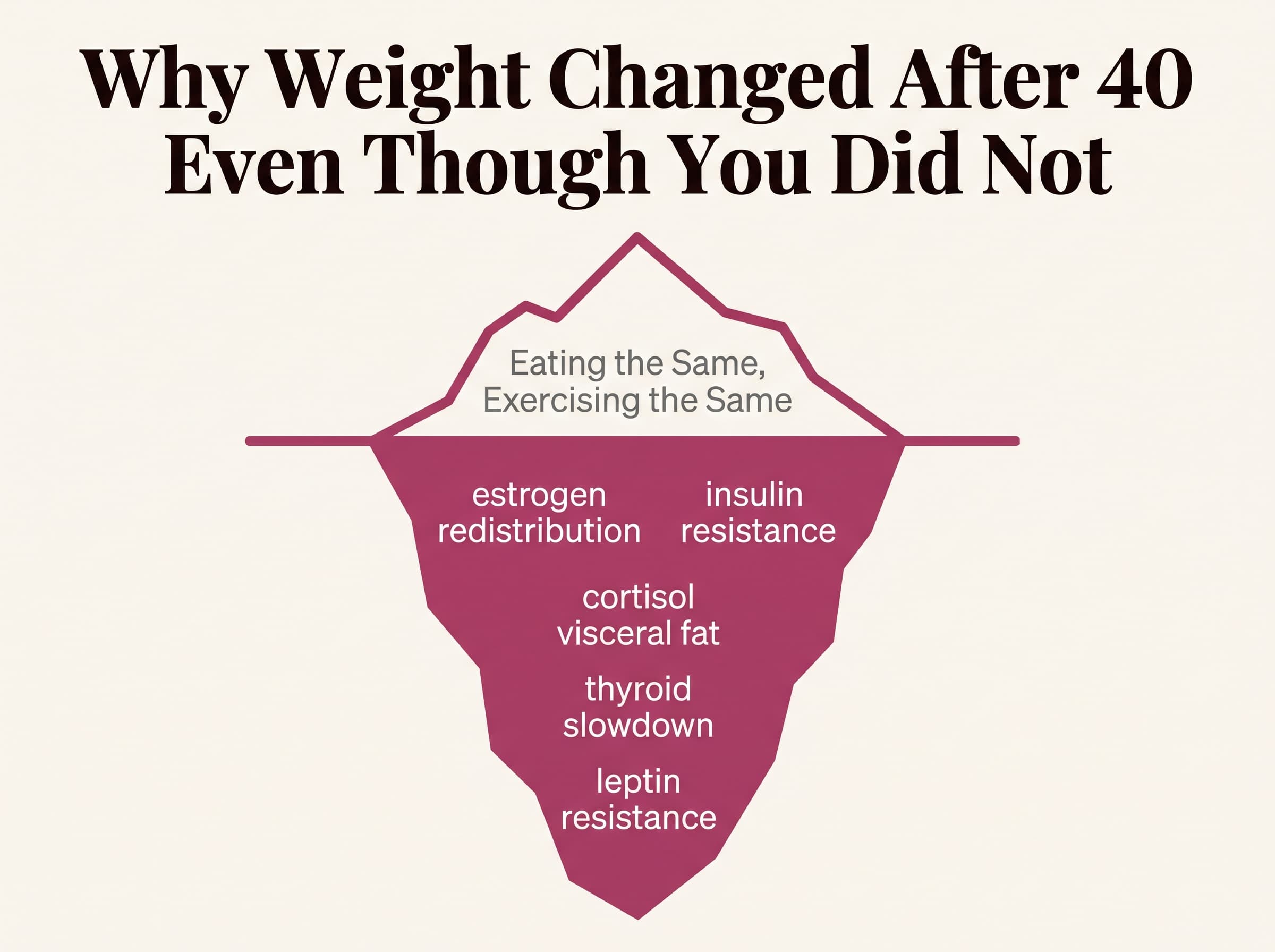
Why Your Weight Changed After 40 Even Though Nothing Else Did
You have not changed what you eat. You have not stopped exercising. You may
even be eating more carefully than you were at 35. And yet something is
different about your body in a way that no amount of dietary discipline seems
to fully address.
This is one of the most common and most frustrating experiences of
perimenopause, and it is almost universally misattributed to slowing metabolism
from aging or a failure of dietary discipline.
The actual explanation is hormonal. And the interventions that work address
the hormonal environment rather than simply restricting input further in a
system that is already not responding to restriction the way it used to.
The Five Hormonal Changes Driving Weight Redistribution After 40
1. Estrogen Redistribution of Body Fat
Estrogen actively directs fat storage away from the midsection and toward
the hips and thighs through its effects on fat cell receptor distribution.
When estrogen levels fluctuate and eventually decline in perimenopause,
this directional influence weakens.
Fat that would previously have been stored peripherally — in the hips, thighs,
and buttocks — begins redistributing to central visceral depots surrounding
the internal organs. This is a change in where fat is stored, not necessarily
in total fat mass. Women often describe their body shape changing even when
their weight on the scale has not changed dramatically.
Visceral fat is metabolically distinct from subcutaneous fat. It is more
inflammatory, more hormonally active (producing estrogen through aromatase
enzyme activity), and more strongly associated with cardiovascular and
metabolic risk. This is why the midsection weight gain of perimenopause is
not purely cosmetic — it represents a change in metabolic risk profile.
2. Insulin Resistance
Estrogen has direct insulin-sensitizing effects on cell membranes and insulin
receptors. As estrogen declines and fluctuates, insulin sensitivity
decreases — meaning the same carbohydrate intake that produced no adverse
metabolic effect at 35 may now produce a more pronounced insulin response,
more fat storage signaling, and less effective energy metabolism.
This is why many women notice for the first time in their 40s that certain
foods seem to affect them differently. It is not imagination. The metabolic
response to those foods has genuinely changed because the hormonal environment
governing that response has changed.
3. Cortisol-Driven Visceral Fat
The HPA axis becomes less stable during perimenopause, contributing to higher
baseline cortisol levels and a more reactive stress response. Cortisol
directs fat specifically to visceral omental tissue — the fat depot
surrounding internal organs — because omental fat cells have approximately
four times more cortisol receptors than subcutaneous fat elsewhere in the body.
A woman eating a disciplined diet under chronic cortisol elevation will
continue to accumulate visceral fat because the cortisol signal directing
fat to that depot is louder than the dietary signal. This is the mechanism
behind the observation that stressed women in perimenopause accumulate belly
fat even under caloric restriction.
4. Thyroid Function Changes
Autoimmune thyroid conditions — most commonly Hashimotos thyroiditis —
have their highest incidence in women between 40 and 55. Subclinical
hypothyroidism, where TSH is elevated but Free T4 remains within range,
affects approximately 10 to 20 percent of women in this age group.
Even mild thyroid dysfunction reduces metabolic rate, impairs fat metabolism,
increases fluid retention, and produces the fatigue that reduces the
spontaneous physical activity that contributes to energy expenditure.
Standard thyroid panels that report only TSH and T4 miss the functional
thyroid picture that includes Free T3, Reverse T3, and ferritin — all of
which affect how efficiently thyroid hormone reaches and activates target cells.
5. Leptin Resistance
Leptin is produced by fat cells and signals the brain to reduce appetite
and increase energy expenditure when fat stores are adequate. Leptin
resistance — where the brain stops responding to leptin's satiety signal
despite adequate or elevated leptin levels — is more common in perimenopause
and contributes to persistent hunger and reduced metabolic rate even in the
presence of adequate body fat.
Visceral fat accumulated during perimenopause is metabolically active —
producing inflammatory cytokines, estrogen through aromatase activity, and
insulin-disrupting compounds that compound the hormonal imbalance that
created it. Addressing visceral fat is not primarily a cosmetic priority.
It is a metabolic health intervention.
The Interventions That Actually Address the Cause
Resistance Training Over Chronic Cardio
For perimenopausal women, resistance training is the most important form
of exercise for body composition — more important than cardio and more
important than caloric restriction for long-term outcomes.
Muscle tissue is one of the primary sites of insulin-mediated glucose uptake.
Building and maintaining muscle mass directly improves insulin sensitivity,
raises basal metabolic rate, and counteracts the muscle loss that accelerates
after 40 due to declining anabolic hormones.
Chronic high-intensity cardio elevates cortisol for 24 to 48 hours post-exercise
in women who are already cortisol-dominant, adding to the visceral fat storage
signal. Daily walking is specifically anti-inflammatory and cortisol-regulating
without the cortisol cost of high-intensity steady-state cardio.
The evidence-based exercise protocol for perimenopause weight management:
resistance training three times weekly, daily walking, and high-intensity
intervals limited to two sessions of 20 minutes maximum per week.
Protein Prioritization
As estrogen declines, muscle protein synthesis becomes less efficient.
The leucine threshold required to activate muscle protein synthesis increases,
meaning more protein per meal is needed to achieve the same anabolic effect
as at 35.
The evidence-based target for women over 40 is 1 gram of protein per pound
of body weight per day, distributed evenly across three meals at 30 to 40
grams per meal rather than concentrated at dinner. This protein distribution
maintains muscle mass, improves insulin sensitivity, and anchors blood sugar
throughout the day.
Blood Sugar Management as a Primary Strategy
Given declining insulin sensitivity, managing blood glucose variability
becomes a direct weight management strategy, not just a metabolic health
concern.
The most evidence-supported dietary interventions for perimenopausal blood
sugar management:
- Protein and fat before carbohydrates at any meal reduces postprandial
glucose spike by 36 to 44 percent compared to eating carbohydrates first - Vinegar before largest meals (one tablespoon apple cider vinegar in
water) reduces postprandial glucose by 20 to 30 percent through enzyme
inhibition - 10 to 15 minute walk after meals reduces postprandial glucose by up to
30 percent through muscle-mediated glucose disposal
Stress and Cortisol Reduction as Weight Management
For women with significant cortisol-driven visceral fat, stress management
is not a complementary lifestyle recommendation. It is a direct metabolic
intervention that must precede dietary restriction to be effective.
Caloric restriction in a cortisol-dominant physiological state elevates
cortisol further through the perceived scarcity signal, worsening the hormonal
driver of visceral fat accumulation. The correct sequence: reduce cortisol
first through sleep optimization, appropriate exercise, and stress reduction;
then address dietary composition; then if needed, address caloric intake.
For the complete perimenopause weight management guide including meal timing,
supplement evidence, and the hormonal testing that reveals the specific drivers
in individual cases, visit
perimenopauseedit.estorealm.com.
Frequently Asked Questions
Why does eating less make perimenopause weight gain worse?
Severe caloric restriction is a physiological stress that elevates cortisol,
suppresses T3 thyroid hormone conversion, and reduces lean muscle mass —
all of which worsen the hormonal drivers of perimenopause weight redistribution.
This is the mechanism behind the observation that restrictive dieting in
perimenopause often produces poor results despite significant effort. The
approach that works addresses the hormonal environment rather than simply
reducing intake further.
Does HRT help with perimenopause weight gain?
HRT does not produce weight loss, but it addresses the hormonal environment
that is driving weight redistribution. Specifically, estrogen restoration
reduces the shift of fat storage from peripheral to visceral depots, improves
insulin sensitivity, and reduces the cortisol dysregulation that contributes
to abdominal fat accumulation. Women on HRT report less weight redistribution
to the midsection than women not on HRT, even when total weight is similar.
Is the weight gain of perimenopause inevitable?
The hormonal changes that drive weight redistribution are a normal part of
the perimenopausal transition, but the degree to which they affect body
composition is significantly modifiable through lifestyle intervention.
Women who maintain adequate protein intake, consistent resistance training,
and blood sugar management through perimenopause experience substantially
less visceral fat accumulation than those who do not, regardless of hormonal
status.
Why has my usual exercise routine stopped producing the same results?
Exercise that maintained body composition in your 30s may be insufficient
in perimenopause for several reasons. Declining estrogen has reduced the
anabolic signaling that supported muscle maintenance. Chronic cardio without
resistance training now produces more cortisol cost relative to benefit.
And the metabolic rate contribution of any given exercise session decreases
as muscle mass declines without deliberate resistance training to maintain it.
Should I be intermittent fasting in perimenopause?
Extended fasting protocols — particularly 16-hour or longer fasting windows —
can be counterproductive in perimenopausal women who are already
cortisol-dominant. Fasting activates the cortisol stress response, which in
the context of existing HPA axis instability can worsen visceral fat
accumulation rather than reducing it. A modified approach — a 12 to 14 hour
overnight fast with protein consumed within 30 to 60 minutes of waking —
provides some metabolic benefit without the cortisol cost of extended fasting.
This article is for educational purposes only and does not constitute medical
advice. Please consult a qualified healthcare provider before making significant
changes to your diet or exercise routine.
More from The Perimenopause Edit
What Perimenopause Does to Your Bones (And the Window You Cannot Afford to Miss)
Bone density loss accelerates dramatically in the years around perimenopause. The interventions that protect it must begin before significant loss has occurred. Here is the evidence on the window, the risks, and what actually works.
The Nutrition Formula That Actually Works for Women After 40 in Perimenopause
Nutritional requirements change in perimenopause in specific, documented ways. The formula that works after 40 is not a clean eating plan. It is a targeted approach addressing the hormonal, metabolic, and structural changes that make standard dietary advice insufficient.
The Neurochemical Reason Your Mood and Anxiety Changed in Perimenopause
New-onset anxiety in your 40s with no clear life trigger is not a psychological problem. It is a neurochemical one. Here is the mechanism and what addresses it at the level it is actually occurring.
The next the perimenopause edit essay in your inbox.
One careful letter, every Sunday. Free.